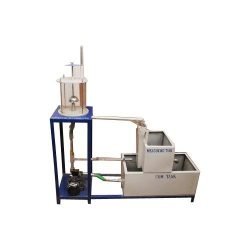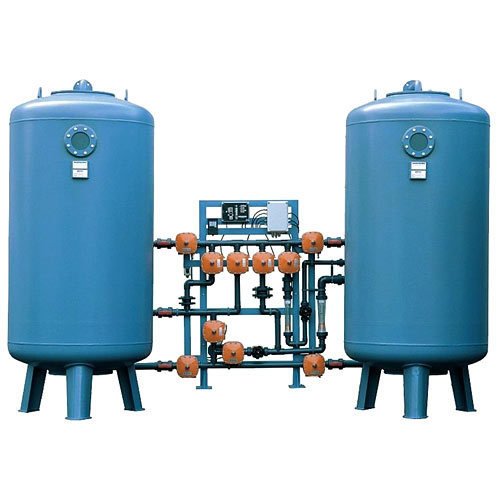
Ion Exchange Unit is used to exchange the ions. The transfer of ions occurs between two electrolytes or between an electrolyte solution and a complex. Ion exchange refers to purification, separation, and decontamination of aqueous.
Applications of Ion Exchange:
Demonstration Capabilities
Water Softening Theory
The usual ion exchange material employed in water softening is a sulphonated styrene-based resin, supplied in the sodium form. This has a strong affinity for calcium and magnesium ions and will also remove ferrous ions after the almost complete removal of calcium and magnesium. Softening may be carried out as a batch process by stirring a suspension of resin in the water until equilibrium or an acceptable level of hardness is reached. It is more convenient to operate as a continuous flow process, passing the water slowly downwards through a column of resin beads. The exchange reaction takes place rapidly enough for the upper layers of the bed to approach exhaustion before the lower layers are able to exchange ions. Thus there is a zone of active exchange which moves down the column until the resin at all depths becomes exhausted. The position at an intermediate stage is illustrated.
When the zone of active exchange reaches the bottom of the column the emerging water begins to show an increasing hardness. This is the breakthrough point when it becomes necessary to regenerate the resin with a strong sodium chloride solution.
Technical Details
Pump: Self priming diaphragm type
Flowmeter range: 10-80ml/min
Sump tank capacity: 20 litres
Anion exchange resin: 0.75 litre
Cation exchange resin: 1litre
Chemicals required (not supplied):
Sodium chloride
Hydrochloric acid
Sodium hydroxide
Ordering Specification
Self-contained apparatus either for single bed water softening or double bed system for demineralisation. Two vertical transparent tubes house the resins. A manifold at inlet/outlet allows flow configuration changes. Equipment includes pump, valves, conductivity meter and sumps for regenerant and test or wash solutions. Typical commercial cation and anion resins are supplied.
Recommended Equipment
Cartridge type water deioniser
Replacement cartridges
Beaker cell
Services Required
Electrical supply:
220-240V/1ph/50Hz
120V/1ph/60Hz


Research Lab
Research Lab
Physics Lab Equipment's
Biology Lab Equipment
© Copyright 2025